Friday, 12 June 2020

Baskets, bags, boxes and bamboo tubes.


Far be it from me to be dismissive of Julie Andrews- she's a Dame, a "national treasure" and an eighty four year old woman- but I've always been underwhelmed by the list of "favourite things" that she sings about in The Sound of Music- it takes more than "whiskers on kittens, bright copper kettles and warm woolen mittens" to put a smile on my face, but perhaps that's the point. Such lists are subjective, and aren't guaranteed to be received with the same enthusiasm as is shown by the one moved to share them.

I was reflecting in an absent minded moment recently on my own fishing "favourite things" list, and realising that it isn't just the expected things that bring me pleasure, but often the little things that might to someone else appear incidental and unimportant.
So, in the spirit of Maria, and with not a "lonely goatherd" in sight, here are a few of my (piscatorial) favourite things:

Now, if honesty is allowed momentarily to trump angling romanticism, an old style willow basket is not the most comfortable of items on which to park one's posterior but that in no way detracts from my affection for mine. (Point of clarification: I refer to my affection for my basket, not my posterior!) A present from my wife, purchased from a well known internet selling site (yeah, you know the one) it was, as they say, "pre-owned" and  required a fair degree of TLC upon first arriving- a good clean with soapy water, followed by a coating of boiled Linseed Oil, but the result is a basket that has been accompanying me on fishing adventures for the best part of 15 years, and definitely finds a place in my favourite things list.


There are, however, days when a bag is preferable to a basket, and on such days a more recent acquisition takes its place in my prized possessions list. It's a trout fishing bag (although in my case, always employed for "coarse" rather than "game" purposes), which, although inexpensive, in it's colouration and style, and with it's leather buckles, conforms exactly to the image in my mind of what a good fishing bag should look like.

Also deserving of their place are my bamboo float tubes, and boxes full of traditional handmade floats. I have float tubes in both flamed and unflamed bamboo, with minimalistic whippings in black, scarlet and blue. Each holds only a handful of floats, but there is an aesthetic appeal that transcends their functional qualities and, along with many other traditional anglers, such float tubes hold a privileged place in my angling affections.


As well as the tubes, there are the boxes, each with slotted foam to hold the floats secure, with my favourite being one that exclusively houses a part of my perch bob collection, which has been "customised" with a sticker obtained from the USA featuring a shoal of perch twisting and turning in the water with predatory intent.


A constant companion on my fishing trips is my Swiss Army knife, still in immaculate condition despite being moved from tackle box to tackle box a number of times during the course of a season for the last quarter of a century. Its presence tends to be more for its totemic value than for regular use, although it does find itself cutting luncheon meat into cubes and performing various practical tasks from time to time, but I refuse to set off for the riverside or lake without it, still holding onto the boyish notion that a tackle box that doesn't contain a knife is in some way diminished by the absence. It is pictured here in my pike box, although it is mostly to be found in my general coarse box, a yellow and clear perspex Stewart box that I have had since I became a fisherman at the tender age of 13.


The penultimate item that finds its way into my "hall of fame" is my wooden landing net. With a lovely bamboo handle elegantly whipped in burgundy, and with a mesh that although modern, knot-less, and fish-safe, manages still to convey in its appearance  the suggestion of a previous era. Having only a small frame, its use is restricted to  waters that contain fish of only modest proportions, but it is a thing of beauty and always a pleasure to slip underneath a fish.


The final item to feature in my eclectic, but highly personal, list is my Australian bush hat. Given to me twelve years ago by my parents for my 40th birthday, it has not only adorned my head while fishing, but has also accompanied me on safari in East Africa and on a fishing road trip across the Southern States of the USA. It probably only comes with me on three or four fishing trips per year but is another article of my angling related ephemera for which I have an inordinate affection.


So, there you have it. None of these items are the "hardware" of fishing (the rods and reels), none are essential in order to fish, but all form a part of the pleasure of the rich wider tapestry that makes angling such an engrossing hobby in which to immerse oneself.
So, "When the dog bites, When the bee stings, When I'm feeling sad ..." it's to these that I'll turn!


Saturday, 6 June 2020

Roach - the "shoulder padded jacket of the fish world."


My copy of the Observer's Book of Coarse Fishing (a Christmas present from my parents in 1981) informs the reader that the roach is the "best known and most popular" of Britain's coarse fish species, and Bernard Venables in Mr Crabtree goes Fishing  ( I have the 1959, sixth edition, on my bookshelves) concurs, describing the roach as "the most popular of the fishes". Izaak Walton, however took a counter view writing "... the roach is accounted the water sheep for his simplicity or foolishness." Personally, although in matters piscatorial (and theological) I invariably find myself in accord with Walton, in this instance I must side with BV, who contends that " a large roach is most difficult to deceive." Supporting evidence for his claim is the fact that while I have caught numerous roach in excess of a pound, I have yet to land a two pounder.

My fondness for roach is in part a response to their aesthetic attractiveness, in part a result of the fact that they are susceptible to the float fishing tactics that I prefer, and also because they seem to me to be emblematic of a simpler, more wholesome and innocent era in angling history - a time before the cult of the carp and the carp angler had redefined the practice of fishing.


With its bluish green back, metallic silver scales and bold red fins, the roach is possessor of  an elegant and simple beauty - unarguably attractive without being in the least bit "showy".

Many roach have graced my net over the years, and the capture of my first weighing in excess of a pound  (a fish of 1lb 4oz taken in the October school half-term of 1982) remains one of my fondest and most vivid angling memories. I have spent many a pleasant evening fishing for roach with my son (he is pictured here with my brother, Andy, each displaying a nice example of the species), and while I have never indulged in any serious pursuit of the species, I remain hopeful that one day a two pounder will join me on the bank.


Fashions change (hence the somewhat cryptic title of this piece), and it may be that it is the fate of the roach to be the piscatorial equivalent of the steam engine, the VHS recorder or the shoulder-padded jacket, but I hope not, and would love to see a resurgence of affection for species rutilus rutilis. I also really need to do something about the fact that my biggest ever roach was landed by accident while fishing for carp with a boilie on a bolt rig, a method of fishing which seems a crude, disrespectful, and  wholly inappropriate  way to fool such a delicate biting adversary. 
I am (I believe to my credit) suitably embarrassed.


Tuesday, 2 June 2020

On being "In the club..."


According to Brian Adam's the summer of '69 seemed to last forever, although as I was only one year old at the time I feel unqualified to adjudicate on the veracity of his observation. However, 51 years on and the late spring/early summer of 2020 seems already to have been a protracted affair with minutes, hours, days and weeks feeling as if they pass with much less haste than is customary. No doubt the blurring of the normal delineating lines that we use to regiment our days has been a contributory factor with many people furloughed from work, others like myself working from home, children kept from school, and  weeks of confinement at home having been  necessitated as a national response to the coronavirus pandemic. Also playing its part has been the weather, with summer starting earlier than usual and Britain enjoying week after consecutive week of languorous, somnolent sunshine. And so it was, in the middle of a Tuesday afternoon in the first week in June, with the sun high in the sky, my son James and I, accompanied by James's girlfriend Emma, made our first foray to the lake owned by a club we'd just been invited to join by an angling friend and neighbour. After years of mostly day ticket angling I was back in the world of cardboard covered club membership books, newsletters, AGM's and lakes far from the madding day ticket crowd.


We set up in lilly pad fringed swims next to each other, both electing to float fish. I had opted to deploy my vintage 10 foot fibreglass avon rod, matched with an Allcocks Record Breaker reel, and soon both of our floats were dipping and disappearing regularly. Bites were lightening quick, and more were missed than hit, but the result when fish were hooked was a procession of the most beautiful small carp, wonderful scaly mirrors with caramel coloured flanks and darker commons, every one pristine in condition.


Set amid trees, quiet, peaceful, and litter free, this was summer fishing at its most pleasing. Baits were traditional and simple (a can of sweetcorn and a loaf of bread) and the pleasure of fishing was accentuated by the pleasure of fishing as father and son, a pleasure that began when James caught his first fish aged just three and remains as strong sixteen years on. The carp were joined by the occasional roach or rudd (even Emma took a break from spectating and sunbathing to catch her first ever fish), and as late afternoon gave way to evening we packed up and walked back to the car enveloped by a glow of gentle satisfaction. This was simple fishing in pleasant surroundings and good company. Izaak Walton would have approved and understood.


Friday, 22 May 2020

Fishing in a time of pestilence

As a fishing mad teenager my obsession knew no bounds and on discovery that it held a reasonably sized angling section even extended to me taking out membership of the local library (these were the heady, now long since gone, days of the early 1980's when local councils still thought it a worthy enterprise to fund public reading), and so it was that one day I marched euphorically out of the municipal doors with a copy of Dick Walker's "Stillwater Angling" tucked under my arm, mine to have and to hold for a fortnight. At the time Dick had a weekly column in the Angling Times, and even as a youngster I was savvy enough to know that the book I was clutching was viewed as something of a "classic."


However, Dick Walker, onetime carp record holder and pioneer of modern specimen hunting, was wrong on one count: water never is still. Not really still. I'm aware that he was only borrowing a well used phrase intended to distinguish the bodies of water found in lakes, ponds and pits from the flowing water of rivers, but stand by a lake and you'll see that it is never entirely devoid of movement, always exhibiting (however slight) a mesmeric pattern of fluctuating ripples that disrupt the reflections peering back at the observer.

After the enforced break of a few weeks it was good to be back. I stood for a moment and paused, deliberately savouring the sight, enjoying watching the ripples disturbing the water's surface, before setting about the serious business of tackling up. It wasn't long before my float was being flicked into the water with a satisfying "plop", itself momentarily setting off a ripple pattern of its own, before settling to perform the more serious task of bite indication.


From time to time my attention drifted from the float to take in the bigger picture, a cornucopia of delights: clouds scudding across a bright blue sky, the dancing reflections, and the incessantly busy birds, always on the move, never still. Coronavirus may have shaken the world and for a season changed it, but it was powerless to destroy the beauty and majesty of nature.

As my angling fast was being broken only by a brief session ( I had spent the morning working from home, a practice  which now seems to be ubiquitously described as "the new normal"), I brought with me only the bare minimum of tackle: my venerable and lovingly restored Allcocks Wizard, vintage Mitchell 304 reel, a net, and a satchel containing just the absolute essentials.


The afternoon passed slowly. Not in a bad way, but in the happy languorous manner that time moves in when diaries, meetings, schedules and timescales no longer apply. Despite the pleasing way that time seemed not so much to pass, but rather to collect, the fishing activity itself was brisk. Fishing in the margins, the float was continuously dancing, dipping, and disappearing and a steady stream of fish of no great size but  all possessing admirable looks was soon being brought to the bank to be unhooked, admired and returned. The majority of bankside visitors were plump, buttery coloured crucians, although in all I garnered half a dozen species, with the crucians being augmented by the mildly exotic ide, the flamboyantly exotic golden orfe, a handful of gloriously silky small tench, a couple of perch and a solitary bream.


Dave, a frequent fishing partner of mine, was ensconced in the next door swim, and also catching with regularity, similarly bringing a catholic selection of species to the bank, including a lively fully scaled mirror carp which stretched the elastic in his pole admirably and gave a good account of itself before succumbing to the folds of the net.


Among my (if my wife is to be believed, many!) faults, is that I count the fish I catch. I dislike myself for it, because I appreciate each fish for its own merits, and the number of fish caught (or not) is always incidental to my enjoyment of the day, but it's a habit I acquired as a child and have never been able to shake off. This irritating compulsion is compounded by my always trying to end the day with a number divisible by five, not for reasons of superstition but because there seems to my mind something neat about a total ending in ether a zero or a five, and so it was that after four hours of fishing, upon reaching the total of 45 (the largest of which was this bream of only very modest proportions) I "drew stumps", gave the lake another admiring look and packed my tackle back into the car.


It had been a wonderful afternoon, and for now, my need to fish is sated, but not, I suspect for long. The call of the lake is as irresistible as the song of the Sirens, and like  the poet I am duty bound to heed it.

Come when the leaf comes, angle with me,
Come when the bee hums over the lea,
Come with the wild flowers,
Come with the wild showers,
Come when the singing bird calleth for thee.

I'll be back.


Wednesday, 6 May 2020

Bob, bob, bobbing along ...


My favourite fish are perch.
My favourite style of fishing is float fishing.
My favourite float for fishing for perch is a brightly coloured perch bob.

To me the perch is a totemic fish, and the perch bob an iconic float. It's a float which, when tucked in close to an overhanging tree or tight to reeds or vertical structure (such as the "camp sheathing" beloved of Mr Crabtree) screams imminent promise, but even as the angler's intense concentration is focused on a future disappearance, the presence in the water of a perch bob also spirits the fisherman back in time to his boyhood and to the age of his angling innocence. Every schoolboy had a few perch bobs in his tackle box, as do today those adult anglers for whom the romance of the perch has not diminished or been replaced by the hunt for gargantuan, fat bellied, boilie-guzzling beasts of the deep.

I have more perch bobs than I could reasonably justify the need for, but less than I would like. All of mine are handmade, crafted for me either by professional floatmakers Ian Lewis or Paul Duffield, or by my good friend Roy, a true gentleman and former Yorkshire miner with whom I've shared many a pleasant bankside moment.


I have a range that encompasses large (and rarely used) ones that take a couple of swan shot, all the way down to the small ones I most frequently deploy which take just one or two BB. All are made from natural materials, balsa, cork and even oak galls, some are painted to replicate the Harcork classics of yore, others feature spiral whipping, and each is a thing of beauty in its own right.

If using maggots (red, of course) to pursue my beloved stripy quarry I favour the use of a simple waggler of either Norfolk or Sarkandas reed, as the increased buoyancy of the perch bob runs the risk of decreasing sensitivity and alerting the perch to my deceptive intent, but whenever a lobworm or prawn (and very occasionally a minnow) is employed, it will be to the perch bob that I turn as a matter of course.

Recently, I put a few of my perch bob collection in a dedicated float box (handy to chuck in a satchel for impromptu last minute trips), and even, rather indulgently,  took delivery from the United States of a brightly coloured decal featuring a shoal of perch to decorate the box's lid.


It may be a while before we fish again in this year disrupted by pandemic, but I hope that by the time we reach Keats's "season of mists and mellow fruitfulness" a time when the angler's mind naturally turns to thoughts of perch, that I will be found, crouched by a pond, cane rod in hand, finger on the spool of the centre pin, poised to strike at the disappearance  of a brightly tipped, bulbous bodied perch bob. In its simplicity and serenity, my happiness, consists of such moments.


Sunday, 5 April 2020

(Fishing) lines around my father

Social isolation does strange things to a man.
Coronavirus, or Covid19 to employ the inappropriately jaunty sounding moniker beloved of journalists and media types, had put paid to a long planned and much anticipated fishing weekend that my brothers and I had arranged, and on what should have been the second evening of our fraternal fishing adventure I found myself lounging prone on the sofa, glass of wine in hand, with my mind meandering like a slow paced river, and improvising around philosophical themes with an angling root.
I have recently reread "For all those left behind", written by John Andrews of "Andrews of Arcadia" fame, a hauntingly beautiful account of his adult re-conversion to fishing, a pastime that he'd earlier shared in his childhood and youth with his father, a book which above all else is a deeply personal exploration of bereavement and loss, and of how we hold people and events in our memories. Perhaps it was a consequence of his exquisitely penned recollections of his father, that caused a long-lost memory to reactivate itself in my brain; the memory of stream caught brown trout, cooked in the kitchen of a small suburban town house in Reading.


My father is not an angler. Fishing began for me and my two brothers in the summer of 1981, a summer of scorching hot weather and an ill fated royal wedding, and was entirely a decision of our own volition. There was no family history of angling (although I suspect that some of the gypsy forbears on my father's side of the family - my father is rightly proud of his Romany roots - knew a thing or two about poaching), but we lived five minutes walk away from a tree and rhododendron fringed lake of about 8-10 acres, which was gloriously and incongruously set in the middle of a housing estate, and the three of us had long been drawn to the lake as a place of beauty, excitement and adventure. There was, I now realise, an inevitability that the siren appeal of angling would eventually call out and ensnare us.


We fished almost every day of that summer holiday, our first as fishermen, and by the end of six weeks of solid fishing, I had caught one perch, Andy half a dozen and Tim was yet to catch. To label such a catch rate as "abysmal" would be to deal in understatement, but we were happy; self-taught and constantly learning we devoured fishing books and magazines and were canny enough to realise that there would come a time when the theory we were imbibing would be caught up by our practice and results, as indeed proved to be the case. We fished all through the winter, protected against the chill by inadequate thin anoraks, knitted gloves and Dunlop wellies, and by the following summer had made enough progress for all three of us to be selected to fish for a junior team in a match fishing league.


Our father sometimes accompanied us to "the Lake" (it had a name but to us brothers it was only ever referred to, and still is, as "the Lake"), and although he didn't fish he took a keen interest. Possibly it was a result of his being a science teacher who had always been fascinated by what he would term "pond life", or maybe just a father spotting an opportunity to spend some time with sons whose passions differed from his own. As our obsession grew, so did the desire to try new venues and sometimes he'd not only play the role of taxi driver, but he (and sometimes our mother, too) would pack a folding chair and sit and watch us fish, he often accompanied by a book (almost always on some theological theme), our mother with a ball of wool and a couple of knitting needles, as we (by now competent anglers) swung roach and rudd to hand or landed tench. Even without the sentimentalising effect of nostalgic reminiscence  these were happy days.

The family idyll was ended by the onset in earnest of adolescence. As hormones careered around our teenage bodies boundaries were pushed, new urges and experiences explored and our youthful drinking, smoking, pierced ears and late night scrapes erected barriers in what had previously been a harmonious existence. There were arguments, tears, acts of rebellion and a sense of mutual incomprehension between generations. We remained under the same roof, but often at a distance. But there were moments of affection and rapprochement, one of which brings me back to the memory of stream caught brown trout, cooked in the kitchen of our small suburban town house in Reading.

I have no particular fondness for trout. I concede to the native brown trout its natural beauty, I detest the artificial beauty of the American import rainbow (the piscene equivalent of a plain girl wearing too much make-up), and although as a species they have drawn sublime poetry from Rupert Brook and witty, eliptical observations from John Gierach, I find it hard to respect a quarry so easy to catch that it necessitated the invention of fly fishing to make their capture a challenge. However, my prejudices in respect of trout are incidental to this tale.

One of my best friends throughout my teenage period had a father more emotionally equipped to deal with the maelstrom that is adolescence than my own, and I spent most of my weekends for several years staying over at this friend's house. We chased the same girls (he usually won, and in fact is now married to one of our mutual pursuits!), went to the same parties and I rode pillion on his motorbike. His father was a businessman, endlessly pursuing new opportunities- a builder, a retailer, always restlessly searching for a new project, and so it was that he took an interest in a farming, camping and livery business in Cornwall, and I was invited to join the family for a weekend staying at the potential new business opportunity. Through the farm ran a stream, narrow enough to leap across, its banks tree lined and festooned with vegetation. The die was cast, and my friend and I took telescopic rods, bait boxes of maggots and worms and a handful of floats, split shot and hooks and spent a couple of hours each day trotting the stream. Our reward was a plentiful supply of small brown trout, resplendent in their spotted beauty, the largest of which we summarily knocked on the head and popped in a cooler to take back up with us to Reading.


Which brings the story full circle to my relationship, then strained, with my father and a brief moment of  shared mutual affection.
"I'll cook those for you, Jon" my father offered, and he set to work in the kitchen, coating the trout with flour and egg yolk, seasoning them with herbs and popping them into a frying pan. We ate them together, reminding ourselves of what it was like to enjoy each other's company, for a while forgetting the ongoing conflict between teenage hedonism and my father's more conservative worldview. A moment of communion and re-connection.

Many years have past since that day, I am older today than my father was then, our father/son relationship has long since been repaired, and I too have been a father of teenagers. My father never became an angler, and my own son now fishes with me just a couple of times a year. Despite catching his first fish at the age of just three, his relationship with fishing has been sporadic, and although a competent fisherman who enjoys using a centre pin, the bug has never bitten hard with him and I know that he accompanies me primarily to humour his old dad, rather than out of any irresistible urge to fish, and I in turn am grateful for his gracious condescension.

Whether it's Cat Stevens dispensing seemingly dispassionate life lessons to a son, Mike Rutherford wishing that he and his father had connected on a deeper level in "the living years", or Bruce Springstein recalling sitting on his father's lap in a "big old Buick" and being told "son, this is your home town", the relationship between fathers and sons is a staple for melancholic reflection.
For me, those reflections require recovering the memory of a dated looking 1980's kitchen and a plate of small brown trout, and resolving, as I move through my middle years and he his twilight ones,  to phone my father more often for a chat while we both still inhabit the living years.


Wednesday, 4 March 2020

Fenlandia - a piker's symphony.


"The horizon stooping smiles,
Oer treeless fens of many miles,
Spring comes and goes and comes again,
and all is nakedness and fen." 
John Clare (1793-1864)

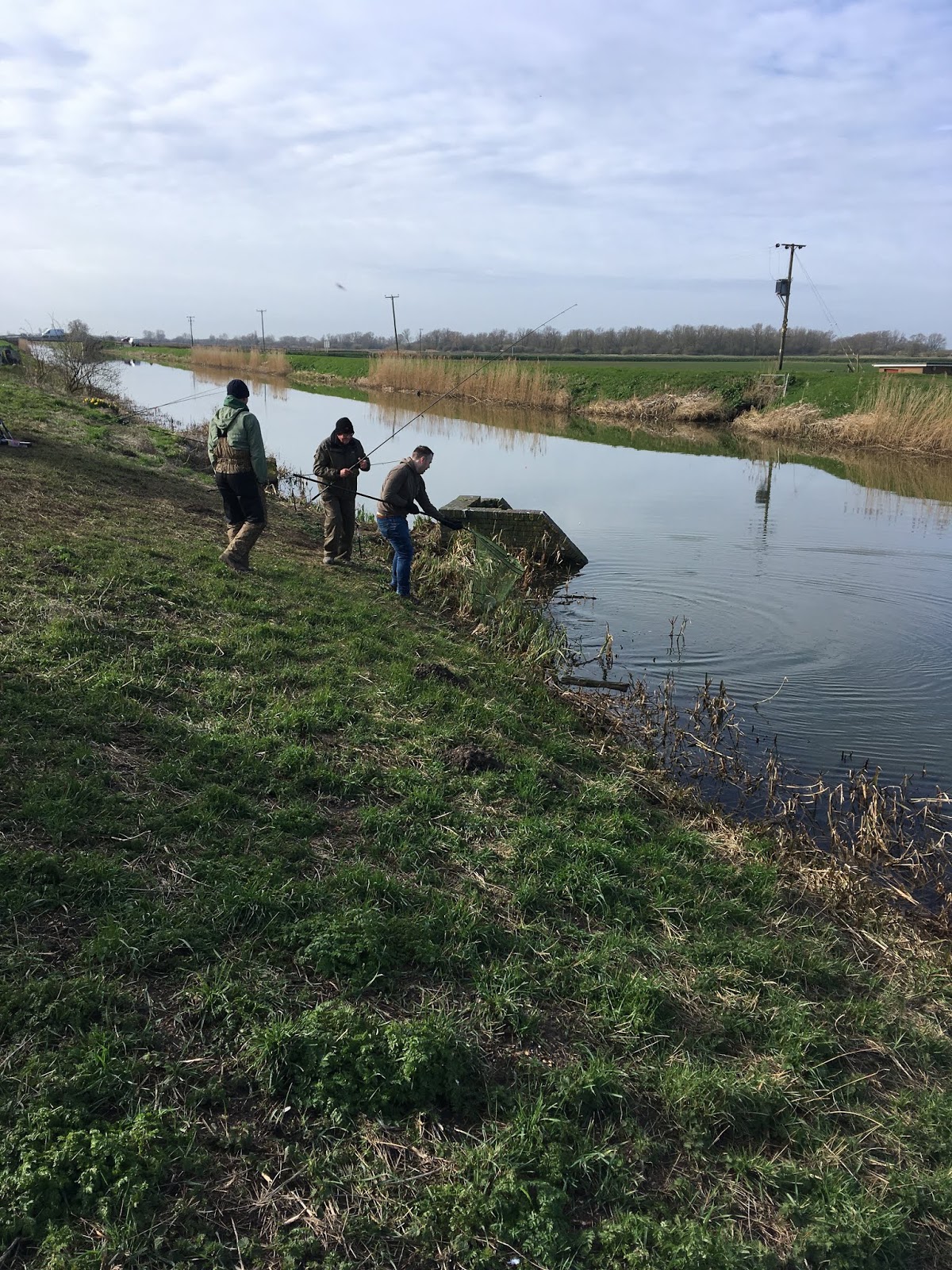
Spring hides itself just around the corner, an inevitability of the changing seasons and the turning on its axis of the globe, but it remains as yet unsprung, although  for the small group of anglers huddled on the Sixteen Foot drain there were the very first signs of winter preparing to retreat and give way to the promise of new beginnings, as we watched our rods, pointed machine gun nest style towards the middle of the drain.  The stark beauty of the flat, agricultural landscape of the big-sky Fens is there to be enjoyed and admired, but while often a gift not for those of faint heart or delicate constitution, today the weather was in uncharacteristically benign mood.


Four of us had made the journey from Leicester to join up with local "Fen Tigers" Ray (who leases the stretch of drain we were fishing), John and Peter, and soon pike boxes were being opened and floats, stop knots and snap tackles assembled as anticipation levels rose. We knew the fishing would be unlikely to be easy, but if just some of us got to tangle with esox all of us would reckon it a good day's sport- it pays not to be greedy on the Fens, and these days I only choose to keep company with anglers big-hearted enough to enjoy another angler's triumphs as well as they enjoy their own.


Our host, Ray, was the first to catch, his fish falling to a float fished sardine deadbait. His pike was followed by a sustained period of watching and waiting, before John's perch livebait was the next to attract the attention of a marauding water wolf. A brief tussle between fish and angling protagonist resulted in the net being swept under John's prize, and soon a lovely mottled green pike was being unhooked and returned to the water, with the only harm done to the fish being the dent to its pride. The pike sulked in typical fashion in the margins before, with a flick of its tail it was gone.


Sport could hardly be described as fast and furious, but occasional pike related activity interrupted the bankside conversation and reverie, Loz losing a pike which flared its gills and shook its head belligerently before throwing the hooks, and me failing to connect with an "unmissable"run as the smelt in the margins at my feet was grabbed by a pike which ran off with its prize in determined fashion, my wind down and strike routine somehow leaving me retrieving nothing other than an eviscerated bait.


We wound the rods in and gathered for lunch, with bacon rolls cooked and provided by John, cream cakes by Ray, homemade cheese scones by Peter, and hot cross buns by Pete. Our Fenland trips are always as much about the enjoyment of each other's company and of the local landscape as they are occasions to catch fish, and lunch was enjoyed at an appropriately leisurely pace.


Pete decided to go for a postprandial wander with a short lure rod and baitcasting reel, and his enterprise resulted in him landing a brace of pike in short order, the largest of which is pictured above.
This proved to be the last of the day's fish catching activity, and stumps were drawn at around half past three in the afternoon, with four pike having been caught, admired and returned.

As ever, our thanks goes to Ray, who not only fulfills the role of host on our annual Fenland pilgrimage, but has become a friend and is always generous with his time and advice- a proper gentleman, and a man whose pike emblazoned van we all look on with a degree of envy.


To complete a near perfect day, just as we squeezed the last bit of tackle into the boot of Pete's car the skies, which had been darkening in hue and growing in threat as the afternoon wore on, opened and began discharging their watery content. We drove home with smiles on our faces.